
Advanced Analytics
Kano Analysis
Focus on features that move the needle, and we can help reveal which attributes customers expect as standard, which will genuinely delight them.
Benefits
Not all features are equal
Allocates customer experience into different types of drivers
Sorts every feature into must-haves, performance drivers and delighters so you know what each one really does for satisfaction.
Identifies delight opportunities
Surfaces the unexpected features that lift satisfaction far beyond what customers consciously ask for.
Prevents wasted investment
Flags the basics that only need to work and the extras that move loyalty, so investment can be focused where it will have the greater behavioural impact
The method
What is Kano analysis?
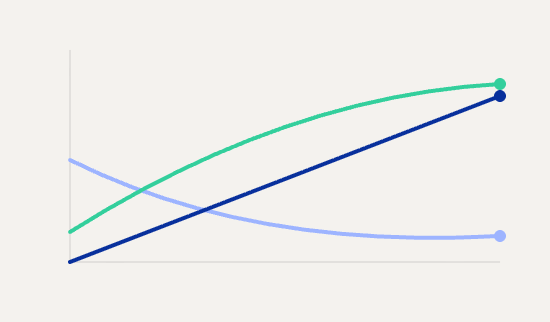
Kano analysis, developed by Professor Noriaki Kano, challenges a common assumption: that doing more of something always generates more satisfaction. In reality, the relationship between feature performance and customer satisfaction is far more complex.
Some features are basic expectations. Deliver them well, and customers barely notice. Fail to deliver them, and satisfaction drops sharply. Others are genuine differentiators that create real delight when present but cause no dissatisfaction when absent. Understanding this distinction changes where and how you invest.
Kano is not limited to product development. The underlying logic applies equally to brand, communications, and service design. Kano is relevant in any situation where understanding the relative role of different attributes helps allocate effort more precisely.
When to use it
Kano is the right tool when the cost of investing in the wrong features is high, and the basis for prioritisation needs to be more than instinct.
01
Product feature prioritisation and roadmap planning
02
Service design and customer experience investment
03
Quality management and value engineering decisions
04
Competitive positioning – identifying where to differentiate
05
Brand and communications attribute testing
Decisions
Decisions it supports
Kano tells you three things about each attribute you test: whether its absence will actively hurt you, whether its presence will actively help you, or whether it sits somewhere in between. That framework applies directly to product decisions, service investment, brand strategy, and communications planning.
Used alongside key driver analysis, Kano adds an important layer. It identifies the features that will actively hurt you if they’re missing, and the ones that can genuinely set you apart if you get them right.
01
Proposition
- Which features are table stakes that we must deliver, and which are genuine differentiators?
- What service levels must we guarantee before investing in premium extras?
02
Brand
- Which brand attributes are expected across the category versus genuinely differentiating?
- How can we surprise and delight customers in ways competitors are not?
03
Customer
- Which experience factors create genuine surprise and advocacy?
- Where is the biggest gap between what customers expect and what we currently deliver?
04
Communications
- Are we communicating features that customers already take for granted?
- Should our messaging lead with reassurance on must-haves or aspiration on delighters?
How it works
Five steps from feature list to real prioritisation.
Crisp, decision-led, and combined with Key Driver Analysis where it sharpens the answer.
STEP · 01
Shortlist features
Define the feature set together. Ten to twenty-five is typical; we trim items that are vague, duplicate or outside the team’s control.
STEP · 02
Design the questioning
Functional and dysfunctional pairs, written in unambiguous language. Pre-test with category users so the categories are not an artefact of the wording.
STEP · 03
Field at the right sample
A few hundred per audience is plenty for clean classification. Sub-group analysis raises the bar; we scope accordingly.
STEP · 04
Classify and size
Each feature placed in its Kano category, with satisfaction and dissatisfaction coefficients to size the effect. We flag features where the audience is split, since that is itself a finding.
STEP · 05
Combine with importance
Layer with other techniques like Key Driver Analysis or MaxDiff to add magnitude to the shape view. The combined output is the actual prioritisation — not the Kano grid in isolation.
Getting started
What you need to begin
- A working feature list — or a hypothesis we can refine together
- A clear definition of the target audience
- A view on capacity constraints so we prioritise against the real choice set
- Any existing feature performance data, if available
FAQ
Frequently asked questions
Kano classifies each attribute based on how it impacts satisfaction: basic (must-have), performance (more is better), and differentiating (delighters). This shows where investment prevents dissatisfaction versus where it creates competitive advantage.
Traditional importance scores assume a linear relationship: more = better. Kano shows that this isn’t true. Some features only matter when missing, while others create disproportionate gains in satisfaction when present.
Yes. Kano works across products, services, brand perceptions, and communications. Any time you are prioritising attributes, the framework helps distinguish hygiene factors from true differentiators.
Key driver analysis shows what is statistically linked to outcomes like satisfaction or NPS. Kano explains the type of relationship. Used together, they show both what matters and how it matters.
Typically 10–25 attributes, depending on complexity and survey length. The goal is to cover the full experience without overloading respondents or diluting focus.
You’ll receive clear classification of each attribute, prioritisation frameworks, and visual outputs that show where to invest, where to maintain, and where to deprioritise.
Kano simplifies complex relationships into categories, so it should be used alongside other techniques for full optimisation. It does not directly model trade-offs or quantify financial impact.
Yes. Kano is particularly effective for prioritisation, helping you allocate resources toward features that drive differentiation while ensuring core expectations are met.
Most studies can be designed, fielded, and delivered within 2–4 weeks depending on scope and complexity.
Get in touch
Ready to run a Kano study?
If you need to prioritise features based on what drives satisfaction, we can help. Get in touch to discuss your brief.