
Advanced Analytics
Key Driver Analysis
The factors that drive your business outcomes aren’t always the ones you’d expect.
Benefits
Isolates what genuinely moves the needle
Prioritises investment decisions
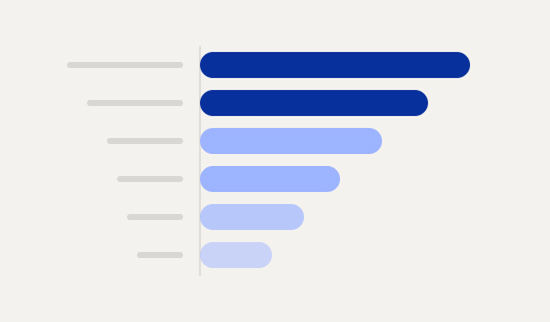
Ranks each factor by how much it actually moves the outcome, so spend goes to what matters most.
Identify areas damaging your customer experience
Isolates the weak points dragging satisfaction down so you know exactly where to intervene.
Build on your brand’s strengths
Reveals the drivers you already lead on so you can protect and extend the advantages that win customers.
The method
What is key driver analysis?
When everything seems to matter, nothing is truly a priority. Key driver analysis cuts through the noise to identify which factors genuinely drive your outcomes and ranks them by the size of their impact, so investment priorities can be defined according to clear evidence.
Key driver analysis (KDA) goes further than standard correlation to identify which factors are genuinely driving your critical business outcomes, whether that’s satisfaction, NPS, loyalty, purchase intent, or brand preference.
The technique draws on multiple sophisticated approaches: regression analysis, Shapley value decomposition, relative importance analysis, dominance analysis, and machine learning. Each controls for confounding factors and isolates the independent contribution of each driver. The output is not a list of associations but a ranked picture of what actually moves the needle, and by how much.
Combined with kano analysis, KDA often surfaces non-linear relationships that standard modelling misses: must-have attributes that damage outcomes when absent but deliver no uplift when present, alongside genuine differentiators that create significant competitive advantage when delivered well.
When to use it
When you need to know where to focus. Key driver analysis is valuable across a range of business decisions.
01
Customer satisfaction improvement and NPS driver identification
02
Brand health – identifying which attributes drive consideration and preference
03
Customer experience investment and touchpoint prioritisation
04
Churn reduction – understanding what drives attrition
05
Budget allocation across products, services, and channels
06
Employee engagement driver identification
Decisions
Decisions it supports
Key driver analysis is most valuable when you need to move beyond instinct and allocate resources with confidence.
01
Proposition
- Which features drive purchase intent?
- How do we optimise our offering for maximum appeal?
02
Brand
- Which brand attributes drive consideration and equity?
- Where should brand-building investment be concentrated?
03
Customer
- Which touchpoints have the most impact on satisfaction?
- What genuinely drives loyalty and reduces churn?
04
Communications
- Which messages shift brand perception?
- What content drives engagement and action?
How it works
Five steps from signal to actionable drivers
The most appropriate modelling approach is selected based on the data and objectives, drawing on techniques such as regression, Shapley values, dominance analysis, and machine learning. Every model is rigorously validated before any findings are shared.
STEP · 01
Define objectives
Identify the outcome to model and the key business question it needs to answer.
STEP · 02
Prepare data
Structure and refine the dataset, whether from existing trackers or new research, ensuring it is ready for modelling.
STEP · 03
Select approach
Apply the most appropriate techniques, including regression, Shapley value decomposition, relative importance analysis, dominance analysis, and machine learning.
STEP · 04
Build model
Estimate the independent contribution of each driver, isolating true impact from simple correlation.
STEP · 05
Validate results
Test the model using hold-out samples to confirm accuracy and ensure findings are robust and reliable.
Getting started
What you need to begin
- A clearly defined business outcome to model against
- An attribute list — or a working hypothesis we can refine together
- Existing tracking or survey data, if you have it
- A view of how the answer will translate into investment
FAQ
Frequently asked questions.
Correlation measures association. When one variable changes, another tends to change. KDA employs techniques that control for confounding factors and isolate the independent impact of each driver. That distinction matters. Correlation tells you what moves together. KDA tells you what genuinely influences what.
Machine learning exhaustively tests thousands of model specifications, variable combinations, and approaches to find the strongest possible model. It removes analyst bias, never misses interaction effects, and consistently achieves higher predictive accuracy. Explainable machine learning makes these models transparent and actionable.
We set aside 20–30% of the data before building the model, then test its predictions on that hold-out group. Strong models predict hold-out outcomes accurately. Where possible, we also validate against actual behavioural data, such as purchases, renewals, and referrals, to confirm that attitudinal drivers translate into actions.
Yes. KDA works well with existing brand trackers, satisfaction programmes, or employee engagement surveys. We need the outcome measure and the potential driver questions. This is often the most efficient approach, leveraging existing research investment rather than commissioning new fieldwork.
Get in touch
Ready to run a key driver analysis?
If you need to understand what’s truly driving your outcomes, we can help. Get in touch to discuss your brief.
Related
Related methods.
Machine learning
Uncover patterns and predictions that traditional analysis can’t reach.
Read moreKano analysis
Prioritise features based on what drives satisfaction, not just stated importance.
Read moreMaxDiff
Force real trade-offs to reveal what truly matters to customers.
Read moreConfirmatory modelling
Test your theories about how your market works with rigorous statistical validation.
Read more