
Advanced Analytics
Segmentation
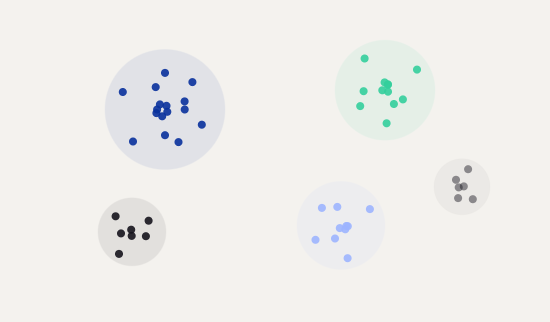
Stop treating every customer the same. Effective segmentation reveals the genuine differences in how customers think, behave, and decide.
Benefits
Decisions based on evidence, not assumption
Enables targeted marketing
Direct your spend at the segments that matter most, not at an “averaged” audience that doesn’t really exist.
Personalisation strategies
Tailor messages, channels and offers to the values, attitudes and behaviours of each group.
Uncovers key audience differences
See the genuine fault lines in your market — what people need, believe and do — beyond demographic descriptors.
The method
What is segmentation?
Segmentation offers a sharper basis for targeting, product development, and resource allocation than demographic groupings alone can provide.
Segmentation groups customers by what actually differentiates them- their needs, attitudes, and behaviours- so that you can target, message, and design for each one effectively.
Demographics describe who customers are. Needs-based, attitudinal, and behavioural segmentation reveals what they value, how they decide, and what will move them. That shift, from descriptive to actionable, is what makes segmentation commercially useful rather than academically interesting.
The most effective segmentations are simple, pragmatic, and built to last. Complex, over-engineered solutions may be statistically sophisticated, but they rarely survive contact with the business. Segments that capture real, observable differences are the ones that teams can act on.
When to use it
When you suspect your customer base is more varied than your current approach reflects, segmentation finds the fault lines.
01
Customer targeting and prioritisation
02
Product development and proposition design for specific groups
03
Marketing message personalisation and channel strategy
04
Customer journey mapping and experience optimisation
05
Pricing strategy by customer segment
06
Market sizing and opportunity assessment
Decisions
Decisions it supports
Segmentation sharpens every downstream decision, from who to target to how to talk to them.
01
Proposition
- How do we evolve our offering for different target groups?
- Which segments have unmet needs we can address?
02
Brand
- How do we gain relevance with specific customer groups without alienating the core?
- Which brand attributes resonate with each segment?
03
Customer
- Which groups should we target and prioritise?
- Which segments offer the greatest lifetime value?
- How do we reduce churn in the segments that matter most?
04
Communications
- Communications: how do we personalise content by segment?
- Which channels and messages work best for each group?
How it works
Five steps from data to durable segments
Rigorous. Algorithm-agnostic. Built to activate.
STEP · 01
Design and fieldwork
Capture discriminating needs, attitudes, and behaviours through carefully designed research. Sample sizes typically need to be 1,000 or more for stable solutions.
STEP · 02
Algorithmic search
Test multiple clustering approaches and variable combinations. We are algorithm-agnostic, iterating across mixture models, k-medoids, partition clustering, ensemble designs, and archetypal analysis to find the strongest solution.
STEP · 03
Validate and refine
Shortlist only solutions demonstrating clear differentiation and commercial viability. Stress-test stability and align with strategic objectives.
STEP · 04
Profile and size
Describe each segment comprehensively: who they are, what they need, how they behave, and quantify market opportunity and value
STEP · 05
Activate
Deliver typing tools for qualitative recruitment, future survey allocation, and CRM overlay where feasible.
Getting started
What you need to begin
- A clear strategic question segmentation should answer
- Target audience definition and any sub-audiences of interest
- Existing data, hypotheses or working segment models to challenge
- A view on how segments will be activated: marketing, CRM, product, or all three
FAQ
Frequently asked questions.
This is a common request but rarely straightforward. CRM systems typically lack the attitudinal and needs-based variables that define segments, making probabilistic mapping unreliable. An alternative is reverse segmentation, aggregating survey data by CRM variables before clustering. This enables accurate CRM mapping but reduces differentiation. It works well when activation is the priority, and marginal differences still drive ROI.
Cluster analysis assigns each customer to one segment based on similarity. Archetypal analysis identifies a small number of pure, extreme profiles and describes each customer as a mixture of those archetypes. This better reflects reality, as people rarely fit neatly into one box, but it is harder to explain and activate. Cluster solutions are more common in practice.
With care. Scale bias and cultural differences in how survey questions are interpreted can skew segmentation solutions. The approach can identify global segments that exist across markets, or local segments unique to each one. The most robust approach is to develop a core framework that adapts to local context rather than forcing identical solutions everywhere.
Generally, no. Demographics should be used to profile and describe segments, not to create them. Demographic-based segments rarely produce actionable differences in needs or behaviours. Modern consumers of the same demographic can have very different priorities. Use demographics to understand who is in each segment, not to define the segments themselves.
Get in touch
Ready to run a Segmentation study?
If you need to define customer groups that drive real decisions, we can help. Get in touch to discuss your brief.
Related
Related methods
Machine Learning
Uncover patterns and predictions that traditional analysis can’t reach.
Read moreMaxDiff
Force real trade-offs to reveal what truly matters to customers.
Read moreConjoint analysis
Model real-world choices to optimise products, pricing, and positioning.
Read moreKano analysis
Prioritise features based on what drives satisfaction, not just stated importance.
Read more